How to Teach Kids About Money: Practical Steps for Parents

The best way to teach kids about money is to put small amounts of real money in their hands and talk through the choices out loud. Start early, keep each lesson short, and let them make cheap mistakes while the stakes are low. You don’t need to be a financial expert to do it.
I’ve written about kids and money for years, including a monthly Family Cents column (details in my Parents’ Press client update). The same few ideas keep working.
Why start talking about money early
Kids pick up money habits long before they can do math. They watch you pay, grumble, splurge and skip things, and they draw conclusions.
Wait until the teen years and you’re undoing habits instead of building them. A five-year-old can grasp “we’re saving for that.” A fifteen-year-old with a debit card needs a lot more.
The Consumer Financial Protection Bureau has age-by-age ideas in its Money as You Grow guide. It’s a free checklist, and a decent one.
Use everyday moments: shopping, bills and choices
You already have the classroom. It’s the grocery store, the gas pump and the kitchen table.
- Let a young child pick between two cereals, then explain why you bought the cheaper one. Or why you didn’t.
- Hand an older kid a $30 grocery budget and a list. Watch what happens at the checkout when the total hits $34.
- Show them a utility bill and ask how they’d bring it down.
- Say “no” to a purchase and frame it as a trade-off, not a rule: “We can have the movie night or the takeout, not both.”
I covered more of these in 10 easy frugal lessons to teach your kids.
Spend, save and give: the three-jar method
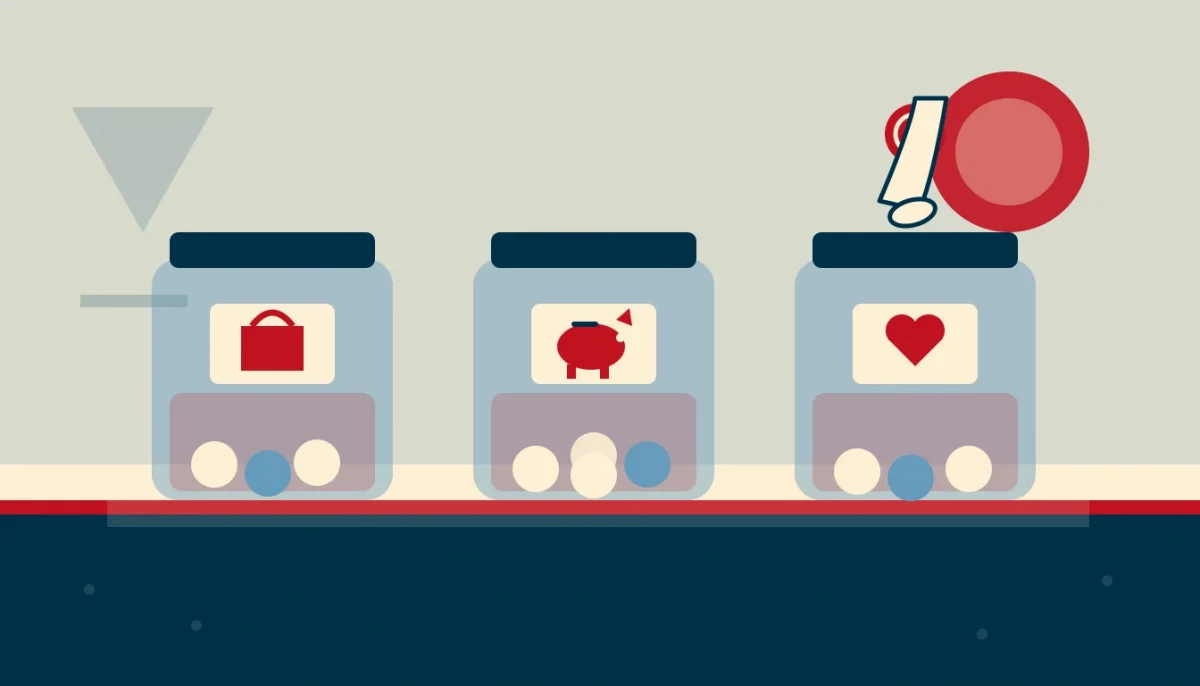
The three-jar system is what it sounds like. Every dollar a child receives gets split into a spend jar, a save jar and a give jar. Real, see-through jars work best for younger kids because they can watch the pile grow.
Here’s a hypothetical $10 weekly allowance, just for illustration:
- Spend: $5 for whatever they want, with no commentary from you.
- Save: $3 toward a goal they picked, like a toy or a game.
- Give: $2 for a charity, a gift or a food drive.
That $3 adds up to $156 over 52 weeks, enough for a decent game console accessory or a bike helmet and a few extras. Kids who see that math tend to care about the save jar.
Those ratios are a starting point, so change them as the kid gets older. When a saver wants something that costs more than the jar holds, that’s your lesson in waiting.
Once the habit sticks, simple ways to teach kids about compound interest shows why the save jar can be worth more than it looks.
Allowance and chores: options to consider
There’s no single right answer, and families split on it. Three common setups:
| Option | Upside | Downside |
|---|---|---|
| Flat allowance, no link to chores | Predictable, good for practicing budgeting | Kids may see chores as optional |
| Pay for chores | Ties effort to money | “How much will you pay me?” becomes the answer to everything |
| Hybrid: basic chores free, extra jobs paid | Family duties stay duties; extra effort earns extra | Takes a little upkeep to keep fair |
I’ve weighed in on this before, in a TV interview on allowances. Whichever way you go, be consistent. Pay on the day you said you would.
Games, apps and books as helpers
Board games teach more than you’d expect: budgeting, trading, risk and losing gracefully. I wrote about the financial mistakes board games teach kids. The lessons stick because the loss is only pretend.
Apps and kid-focused debit cards can help older children track spending. Check fees and parental controls before signing up. For little ones, library picture books about saving work fine, and they cost nothing.
Model the habits you want to see
Kids copy what you do, not what you say. Preach saving, then swipe on impulse, and they notice. Believe me, they notice.
You don’t have to be perfect. Admitting a mistake (“I bought that and never used it”) teaches more than pretending you never make any.
Mistakes parents make and what to do instead
- Hiding money talk. Say it plainly, in age-appropriate terms. Skip the scary details.
- Rescuing every mistake. If a kid blows an allowance on candy, don’t advance more. A $5 mistake at age 8 is cheap tuition.
- Inconsistent payment. Late or skipped allowance teaches that the system can’t be trusted.
- Overcomplicating it. One habit at a time beats a full curriculum.
This is general education, not personalized financial advice, and no approach guarantees how a child will handle money later. Your family’s budget and values come first.
FAQ
What is the best way to teach kids about money?
Give them real money in small amounts, let them make choices, and talk through the results. Pair that with your own example. Hands-on practice beats lectures.
Should kids be paid for chores?
It’s your call. Many parents treat basic chores as part of family life and pay only for extra jobs. Others use a flat allowance with no chore link. Pick one and stay consistent.
How do I teach money without being a financial expert?
You only need the basics: spend less than you earn, save for goals, wait before buying. Learn alongside your kids, and use free guides like the CFPB’s.
What is the three-jar system?
It splits a child’s money into three jars: spend, save and give. Kids learn that money has several jobs, and that they get to decide on them before the money is gone.